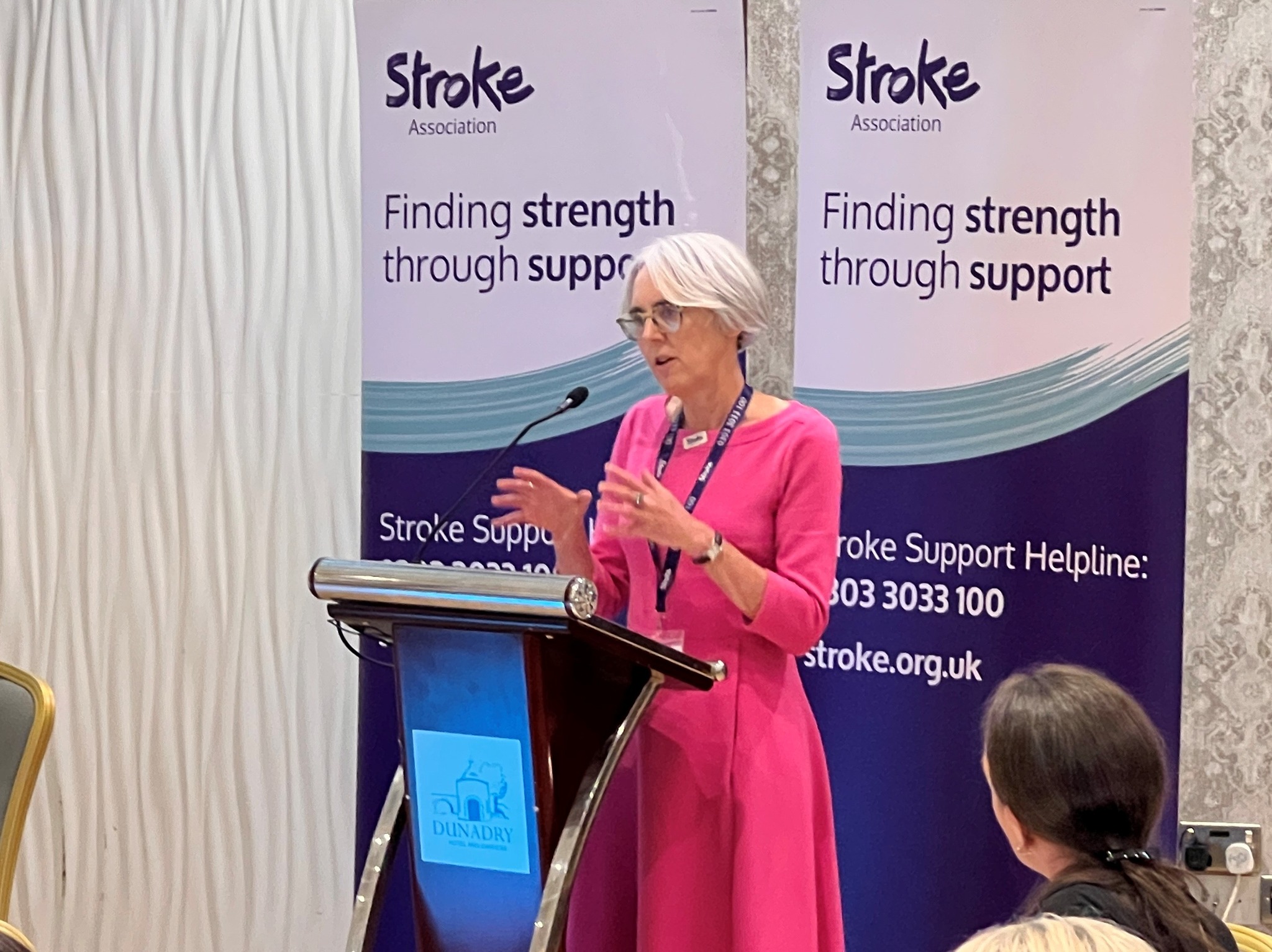
We're delighted you are joining us for the 2025 Stroke Association Northern Ireland Stroke Professionals Conference.
Scroll down to see the final programme and find out more about the speakers. This programme was created with the support of NIMAST.
Countdown to the Northern Ireland Stroke Professionals Conference
Get to know our speakers
Alasdair O'Hara
Alasdair joined the Stroke Association in May 2022. He has a background in charity leadership and campaigning, previously working at Macmillan Cancer Support where he led the Policy and Public Affairs team in Northern Ireland. Prior to this he was the Director of Northern Ireland Stronger in Europe and Head of Policy and Influencing in Scotland and Northern Ireland at the National Deaf Children’s Society. Alasdair leads the Northern Ireland team to deliver for people affected by stroke, influence on their behalf and to raise the profile of stroke and the Association more widely
Dr Patricia Gordon
Stroke Consultant, Clinical Director Stroke Services
Dr Gordon took up post as consultant in 2010. Before joining the Belfast Trust, Dr Gordon worked as a consultant in Altnagelvin from 2009 to 2010. She took up the role as clinical director in April 2023. Dr Gordon’s role includes the teaching of undergraduate students and she provides regular stroke training to the junior doctors in the Trust and is keen to promote and develop medical education supporting them to provide safe, high quality stroke care. She is the current chair of NIMAST (Northern Ireland multiprofessional association of stroke Teams). Through this, she represents Northern Ireland on the Stroke Intercollegiate Working party Group, which has recently developed the updated Stroke Guidelines. In addition, she is a former member of the UKSF planning committee and has been involved for several years in delivering the NI Stroke conference and the first all-Ireland Stroke Conference in 2022.
Fiona Quigg
Deputy Commissioning Lead / NI Stroke Network Coordinator, Dept of Health NI
Fiona Quigg is a Deputy Commissioning Lead in the Department of Health, NI and the NI Stroke Network Coordinator, leading a multidisciplinary cross-sector network to drive improvement in stroke services and patient outcomes.
She is a Chartered Accountant with 23 years health sector experience across strategic planning and performance, regional network coordination, financial planning and performance management, regional capitation formula management and management accounts.
Michael Poots
Michael Poots hails from Dromara and is a school principal and married with three grown up children. Away from work he enjoys the country life, gardening, keeping hens and bees. He is also fanatical about travelling to far flung places.
Louise Clark
Therapy Consultant- Stroke and neuro rehabilitation
Clinical lead- Rowan Rehabilitation Unit (Yeatman) / Dorset Stroke and Neuro Service
Associate Director- SSNAP- King’s College London
Louise is a Consultant Therapist (OT) for stroke and neurological rehabilitation. She is responsible consultant and clinical lead for a 14 bedded stroke and neuro rehabilitation unit and Dorset Stroke and Neuro Service (an integrated community service) in West and North Dorset. Louise has been an associate director with the national stroke audit programme (SSNAP) since 2020 focussing on post acute care. She was the author/editor of the Rehabilitation and Recovery chapter of the National Clinical Guidelines for stroke 2023. Her clinical interests are spasticity, motor relearning and psychological care.
Ruth McMullan
Stroke Service Improvement Manager Northern Health and Social Care Trust
I am an experienced nurse manager having worked in critical care nursing for most of my career firstly in Intensive care and then in Critical Care Outreach. I have over 30 years experience and, spent the first half off my career working in a busy teaching hospital in London. I have a deep commitment to clinical excellence, patient safety and clinical leadership. I managed an Acute Frailty Unit before moving to Stroke Service Improvement Manager in NHSCT. I have always had a passion for Quality Improvement and enjoy leading initiatives focused on improving patient outcomes.
Ann-Marie McIlmoyle
Jessica Elder
I am currently working as a Deputy Sister in RVH Acute Stroke Unit where I took my first Nursing job after university and have been there since 2018! I have a special Interest and passion in providing Palliative and End of Life Care.
Emma Graham
Emma Graham, Stroke Nurse, Ulster Hospital
I have worked within the SET since qualifying as a nurse in 2018, specifically in the Stroke Unit in the Ulster Hospital. I had the opportunity to work within the Stroke Ambulatory team in 2022 and have been with the team ever since.
Dr Hannah Pert
I am currently working as an ADEPT Fellow within the stroke unit in UHD. My main specialty is GP and have just completed GPST2. My aim for the year is to improve our SSNAP score and also participate in ongoing work in improving flow through the stroke unit.
James Gilpin
James qualified as a Registered Nurse in 2001 and has cultivated a rich clinical portfolio spanning Acute Medicine, Surgery and Intensive Care, both in inpatient wards and community settings. Early in his career, he took on the pivotal role of Stroke Lysis Nurse within the Hospital at Night Team, coordinating critical out-of-hours care and honing his skills in rapid decision-making under pressure.
Over the past five years, James has led the Stroke Service Improvement team in his Trust, driving transformational change across pathways and patient experiences. He has spearheaded initiatives ranging from focused service-user feedback programs to the integration of Artificial Intelligence tools in brain scans, ensuring that cutting-edge technology enhances—and never compromises—the delivery of safe, high-quality care.
A lifelong advocate for evidence-based practice and continuous quality improvement, James is passionate about developing staff knowledge, skills and experience. He has served on the Advanced Nurse Practitioner for Older People programme board and is currently Northern Ireland’s representative on the evaluation of the Royal College of Nursing’s Stroke Career Framework, shaping the future of stroke nursing roles nationwide.
Beyond his NHS commitments, James is a freelance lecturer, sharing his expertise across healthcare and charitable organisations. Whether mentoring teams in leadership and human factors or exploring the latest innovations in patient safety, he brings energy, insight and a steadfast dedication to better outcomes for both patients and professionals.
Dr Michael Ford
Michael Ford is a medical registrar training in Stroke and Geriatric Medicine. Currently on rotation in Altnagelvin Hospital having recently completed a stroke fellowship in the royal victoria hospital.
Professional interests focus on hyperacute stroke management, particularly the creation of the PITSTOP protocol active in Altnagelvin hospital which has significantly reduced door in door out times for those transferring out for thrombectomy assessment.
Prof Dominick McCabe
Professor Dominick J. H. McCabe PhD, FRCPI, FESO, FAHA,
Associate Prof. of Vascular Neurology & Clinical Professor in Neurology/Consultant Neurologist
Prof. Dominick McCabe qualified from University College Dublin, initially trained in Neurology in Dublin, and subsequently at the University College London-Queen Square Institute of Neurology (UCL-ION), National Hospital for Neurology and Neurosurgery (NHNN), Queen Square, and Royal Free Hospital, London. During his PhD studies at UCL-ION, he designed and conducted several studies on blood platelets and haemostatic markers in patients with TIA or ischaemic stroke. He was appointed as a Clinical Senior Lecturer/Consultant Neurologist, Royal Free Campus, UCL-ION in 2004, and retuned to Dublin, Ireland in 2006 after completing an Acute Stroke Thrombolysis Visiting Fellowship at the Calgary Stroke Program, Canada in late 2005.
He is currently The Associate Professor of Vascular Neurology & Clinical Professor in Neurology / Consultant Neurologist-Vascular Neurologist, and Chairperson of the Vascular Neurology Research Foundation (VNRF.ie: https://www.vnrf.ie/), Academic Unit of Neurology, School of Medicine, Trinity College Dublin (TCD) / Dept. of Neurology/Stroke Service, Tallaght University Hospital (TUH)-AMNCH. He established and co-directs the ‘Daily, One-Stop Rapid Access Stroke Prevention Service’ with colleagues at TUH-AMNCH for urgent assessment of patients with suspected TIAs, and established and chairs a weekly Regional Neurovascular Multi-Disciplinary Team Meeting at TUH. He has been instrumental in Clinical and Academic Neurology and Vascular Neurology development locally and nationally, and serves on several advisory groups. He is a member of several international organisations, with fellowship of the ESO and AHA.
He is the PI / Co-PI / Collaborator in several local, national and international multi-centre research studies or clinical trials. His innovative translational research programme in stroke medicine and platelet science/haemostasis is led from the Meath Foundation Research Laboratory, TUH-AMNCH/TCD.
His Vascular Neurology Research group has conducted several original translational studies (e.g. PACS, HEIST, TRAP, OATS and OATS-I pilot studies) which have shown that platelets may be excessively activated / hyper-reactive following TIA/ischaemic stroke, and that an important proportion of patients with ischaemic cerebrovascular disease are ‘poorly-responsive’ to commonly-prescribed antiplatelet agents with ‘high on-treatment platelet reactivity (HTPR)’ in the laboratory. They have also found an ongoing stimulus to increased platelet production and secretion, and enhanced platelet and endothelial activation and coagulation system potential after TIA/ischaemic stroke in patients with symptomatic compared with asymptomatic moderate-severe carotid stenosis, including in those who do not have micro-embolic signals (MES) on transcranial Doppler ultrasound. These data improve our understanding of the underlying biological mechanisms which may contribute to the disparity in the risk of TIA/stroke in subgroups of patients with recently symptomatic vs. asymptomatic carotid stenosis, and in subgroups of symptomatic patients with different plaque types and MES status.
His current main research focus is as PI of the ongoing ‘Optimal Antiplatelet Therapy in TIA and Ischaemic Stroke-International (OATS-I) study’ which was planned in collaboration with international expert academic clinicians, platelet scientists, pharmacogenetics scientists, patient advocacy groups and patients, data scientists, industry researchers and health economists. The OATS-I observational study is assessing HTPR status using novel and established laboratory tests, whilst also performing individualised pharmacogenetics testing in all participants following TIA/ischaemic stroke. Predictive models combining clinical, HTPR and cutting-edge pharmacogenetics data will be constructed. The OATS-I consortium aims to identify individual patients with TIA/ischaemic stroke who are at higher risk of experiencing recurrent vascular events on their prescribed antiplatelet regimen, and who should benefit from ‘precision-based antiplatelet therapy’ to optimise cost-effective secondary prevention against future vascular events and dementia.
He is the HRB–Stroke Clinical Trials Network, Ireland, Network Lead Investigator at TUH-AMNCH / TCD (September 2014 to date). He was appointed as Chair of the Research & Education Committee, Irish National Stroke Programme’s Clinical Advisory Group (CAG) for the RCPI/HSE, July 2018 to date, and has collaborated with colleagues on the CAG to plan delivery of the overall National Stroke Strategy between 2022-2027. He collaborates with international experts in Vascular Neurology, Vascular Surgery and Interventional Neuroradiology to publish international clinical practice guidelines.
Dr Sandya Tirupathi
Dr Sandya Tirupathi is a Consultant Paediatric Neurologist and the Clinical lead at Royal Belfast Hospital for Sick Children.
She graduated in Medicine from India and specialised in Paediatrics and Paediatric Neurology in Ireland.
She is a Fellow of the RCPCH. She is a member of national and international professional bodies and member of a few special interest groups and UK wide networks. She teaches on Peadiatric Eilepsy Training (PET) courses regularly in UK. She is on the scientific panel on the European Academy of Neurologists
She has co-authored a chapter on Neurological Disorders for Paediatric Anaesthetics (Book) and has authored and actively collaborated towards a number of publications.
She has varied interests including creating awareness about in general public, adolescent issues in Epilepsy, Stroke awareness, Epilepsy surgery, immune therapies in neurology and neuromuscular disorders. She leads the Neuromuscular services for children in Northern Ireland offering tailored therapies for children with SMA, Congenital Myasthenia and Muscular Dystrophies.
Prof Deb Lowe
Prof Deb Lowe is the and National Clinical Lead for Stroke GIRFT (Getting It Right First Time) Programme and former National Clinical Director for Stroke Medicine at NHS England. She has recently been appointed as Medical Director at The Stroke Association and holds an Honorary Clinical Chair in Stroke Medicine at the University of Central Lancashire.
She has been a Consultant Stroke Physician and Geriatrician at Wirral University Teaching Hospital NHS Foundation Trust since 2005 and still works clinically. She has had many managerial and leadership roles at trust and region over the last 20 years including Clinical Lead for Stroke for the Northwest Coast within the NHSE Strategic Clinical Networks and Senate. Since her appointment into a national leadership role in 2017, she has been keen to promote a culture of effective clinical engagement and compassionate leadership, accurate performance monitoring and the use of high quality data to drive sustainable quality improvement and delivery of evidence based, policy directed care.
As part of the GIRFT stroke programme has met with every stroke service in England in the last 5 years to support quality improvement along the entire stroke pathway, including mechanical thrombectomy. She was instrumental in setting up Integrated Stroke Delivery Network, development of the National Stroke Service Model and Integrated Community Stroke Service Model. Deb co-leads the GIRFT Stroke Leadership Academy at the Royal College of Physicians.
Nicola Moran
Nicola qualified in 1993 from Ulster University as a physiotherapist and worked for 18 years in England , initially in Liverpool followed by 14 years in Portsmouth & eventually returned to NI in 2010. She has worked in neurological & stroke care as a clinician and later as a service manager delivering and developing rehabilitation across the whole pathway including mental health and cancer services . Some of her career highlights include the development of an early supported discharge team in Portsmouth, being the first Allied Health Professional chair of the Northern Ireland Multidisciplinary Association of Stroke Teams (NIMAST) & contributing to both the 2023 National Clinical Guidelines for stroke and NICE guidelines and publishing in the BMJ.
Currently she represents NIMAST at the Intercollegiate Working party, is chair of the stroke network spasticity group and SSNAP rehab group. Alongside her passion for stroke rehabilitation, she is interested in vestibular rehab and spasticity management.
Lynsay Duke
Associate AHP Director for Neurological and Specialist Services
Professional Lead Neuro Occupational Therapy
Spasticity Management Team
AHP Research and Development Lead
Lynsay will talk about services In Walkergate , Newcastle upon Tyne
Lynsay is an Occupational Therapist and has worked in Neuro Rehab for over 30 years and in Spasticity Management since 2008. Lynsay works at Walkergate Park, Neuro Rehab Centre in Newcastle upon Tyne. She was involved in the writing of the 2018 RCP National Guidelines for Spasticity In Adults: management using botulinum toxin. Within the clinic she is involved in the assessment, treatment and review of patients with spasticity. She provides training locally and nationally on Spasticity Management and will be discussing today the development of the Newcastle Service and the importance of the MDT through use of a case study.
Claire Ward
Consultant Physiotherapist - Advanced Clinical Practitioner in Spasticity Management
Wandsworth Community Neuro Team: Claire will talk about development of spasticity services in community
With over 25 years of experience as a physiotherapist specialising in spasticity management and community neurorehabilitation, I am currently working as a Consultant Physiotherapist at St George’s Hospital NHS Trust in South-West London, where my work is focused on advancing AHP-led spasticity outreach pathways. I gained my non-medical prescribing qualification over 10 years ago and in addition to my clinical work, I am an Honorary Lecturer at St George’s University of London, leading the MSc Injection Therapy module. Since 2023, I have been the South West London Stroke Rehabilitation Lead Practitioner for the London Stroke Network and ISDN, further contributing to regional stroke rehabilitation initiatives.
Dr Colum Owens
Dr David McShane
I am an ST6 medical registrar in Geriatric and Stroke Medicine. I have completed my stroke fellowship in the Royal Victoria Hospital in Belfast, and recently completed an ADEPT clinical leadership fellowship in the SHSCT. I am enthusiastic about education and improving stroke services using QI methodology. I have just submitted my Master's in Clinical Education based on the work done over the last year to try and improve stroke triage through simulation training.
Dr Sean O'Reilly
Dr. O'Reilly is a Consultant Neuroradiologist in the Royal Victoria Hospital Belfast. He studied Medicine at Queens University Belfast, graduating in 2010, and underwent neuroradiology fellowship training in the Royal Victoria Hospital, Belfast between 2017 and 2020, obtaining specialist registration in the UK in 2020.
In 2019, Dr O’Reilly obtained the European Diploma in Neurointervention (EDNI), following which he undertook an International Fellowship in Interventional Neuroradiology at UHN Toronto Western Hospital in Canada from 2021-2022. Following a brief period working in the Beaumont Hospital Dublin, Dr O’Reilly returned to work full-time in the Royal Victoria Hospital late last year.Dr Daniel McKernan
I am an ST6 interventional neuroradiologist working in the Royal Victoria Hospital. I am passionate about neurointervention including mechanical thrombectomy.
Dr Niamh Kennedy
Niamh completed her BSc in Psychology from Queens University Belfast (QUB) in 2005. Following this, she was awarded Helen Ramsey Turtle Scholarship to complete a research internship at Harvard University and Boston University in Neuropsychology. She conducted a PhD in QUB investigating the role of neuroplasticity in upper limb recovery following stroke. After her PhD in 2010, she worked for seven years as a Lecturer in Rehabilitation Neuroscience as a member of the Acquired Brain Injury Alliance at the University of East Anglia (UEA). Since 2017 she has worked as Senior Lecturer in the School of Psychology, Ulster University, where she is the lead of the Cognitive Neuroscience lab. Her research interests are in neuroplasticity and neurorehabiltation following stroke and brain injury.
She works with stroke survivors to investigate the interaction between motor, psychosocial, and cognitive aspects of long-term stroke recovery. She has a particular interest in the needs of younger stroke survivors and the long-term impact on all stroke survivors.
Niamh uses a variety of research methodologies, including experimental neuroscience, controlled trials and mixed methods. She works collaboratively with Allied Health Professionals, Neuroscientists, Psychologists and the charity sector.
Niamh sits on a number of key stroke committees, including as a Stroke Association Trustee, James Lind Alliance Priority Setting Partnership for stroke, UK Stroke forum scientific committee/steering group and as Deputy Chairperson N. Ireland Multidisciplinary Stroke Association (NIMAST).Dr Oisín Cleary
Hello, my name is Oisín Cleary and I am a Research Fellow working on the YARNS Transitions Project at the University of Edinburgh. My qualifications include a PhD and a Bachelor of Science with First Class Honours in Psychology, which I obtained at Ulster University in Coleraine. Since beginning my journey through higher education, I have become extremely passionate in the pursuit of cognitive and neuropsychological research within the discipline of Health and Social Science. I have been fortunate to compliment these areas through my PhD where I have gained experience in the implementation of psychological batteries and brain stimulation on individuals who experienced a brain injury. If you are interested in hearing more about my research, please feel free to contact me at ocleary@ed.ac.uk"
Arjay Juan
Charge Nurse, Lurgan Hospital
I have been working in the Stroke Rehabilitation Unit for 8 years. I have a Specialist Nursing Qualification in Stroke Care from Ulster University.
Lauren Jones
Lauren Jones, Clinical Sister in Stroke Rehabilitation Unit, Lurgan Hospital.
Lauren has worked in the Stroke Rehabilitation Unit for 8 years.
Bernie Fox
Stroke Survivor
I was 54 years old when I took my stroke on 4th of July 2013.
I am member of the Buddy Scheme since October 2024
Gillian McKnight
Stroke Survivor
I was 45 when I had my stroke on 7th of October 2013.
I have been a member of the Buddy Scheme since October 2024
Carolee McLaughlin
Carolee is a clinical lead speech and language therapist with over 30 years’ experience in acute and rehab stroke management. She leads on swallowing and communication therapy in RVH and has been involved national working groups developing best practise guidelines for swallowing management in particular FEES and HRM. Carolee has presented nationally and internationally on management of swallowing disorders post stroke and is passionate translating research into clinical practise. Carolee is committed to evidence- based practice and new technologies.
Emma Dunn
Emma Dunn is an Advanced Practitioner Level 2 Occupational Therapist specialising in stroke rehabilitation at the Acute Stroke Unit, Royal Victoria Hospital, part of the Belfast Health and Social Care Trust. She holds a BSc (Hons) in Occupational Therapy from Ulster University.
With 25 years of experience in hospital-based stroke rehabilitation, Emma is dedicated to providing the highest quality, evidence-based care to stroke survivors. She understands the profound impact a stroke can have on individuals and their families, often leading to significant changes and emotional distress. Emma's passion lies in supporting stroke survivors through their recovery journey and offering comprehensive support to their families and caregivers.
In recent years, Emma has developed a keen interest in leveraging technology to enhance rehabilitation outcomes for stroke survivors. Her commitment to integrating innovative solutions into her practice reflects her dedication to improving the lives of those affected by stroke.
Michelle Long
Stroke NSA and Clinical Specialist Physio
I am a Clinical specialist neurological rehabilitation Physiotherapist working in Sussex. I trained in Birmingham at the Queen Elizabeth Hospital and have been qualified for 33 years. I have been a specialist in neurological rehabilitation for 30 years, with the last 20 years as a Therapy Lead; managing a multi-professional team and treating the most complex patients in a level 2a neurological rehab unit. I completed a neurological rehabilitation MSc in 2002, with my dissertation focusing on development of an objective measure for early stance. I have contributed to a chapter on rehabilitation in an ODR for elderly care and have reported on two projects to the BSPRM on goal setting and the FIM FAM. I am passionate about rehabilitation and helping put quality back into life for our patients.
I was seconded to the South East NHSE team, as the Stroke Quality Improvement for Rehabilitation manager, from late 2021 to July 2024 and have recently been appointed as the National Speciality Advisor for Stroke. Both roles put quality improvement at the heart of everything we do and I feel privileged to be on this journey with the stroke community.
